
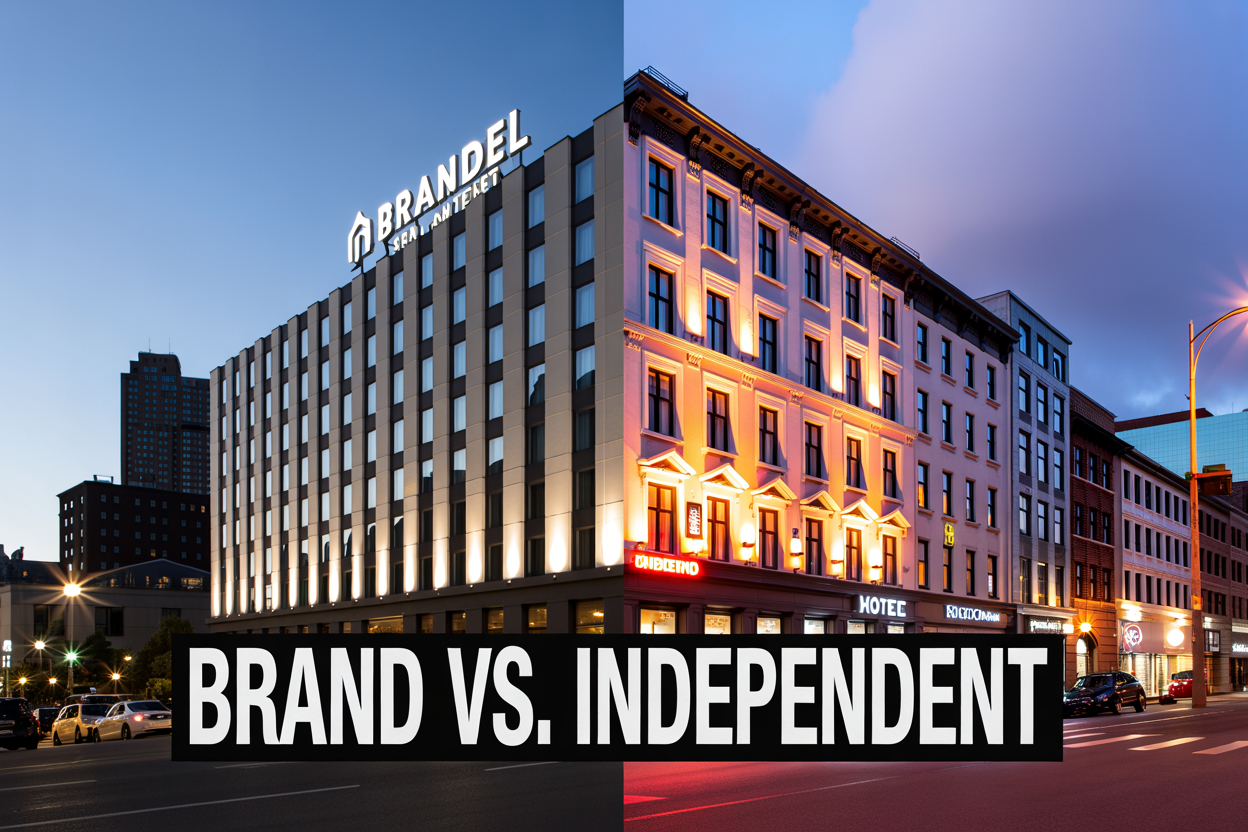
Brand vs. Independent: The Commercial Decision That Will Define Your Hotel’s Revenue for a Decade
You’re developing a hotel, and at some point, someone in the room asks the question that changes everything: “Should we go with a brand or stay independent?”
It sounds straightforward. It’s not.
This is one of the most consequential decisions in hotel ownership strategy, and getting it wrong can quietly cost you millions over the life of the asset. Hotel franchise fees, royalty fees, marketing fees, reservation fees, loyalty program fees — the costs of brand affiliation add up fast, and they don’t always show up clearly in early-stage hotel financial planning conversations. Neither does the full picture of what independent hotel profitability can actually look like when you own your positioning outright.
This guide is written for hotel owners, developers, and investors who are actively working through this decision — or who signed a brand agreement years ago and are now wondering if it still makes sense.
Here’s what we’ll walk through:
- The real cost of choosing a brand — what hotel branding expenses actually look like across a full management cycle, not just at signing
- Where independent hotels hold a genuine edge — from margin control to independent hotel positioning and the freedom to build a guest experience that doesn’t answer to a brand audit
- How this decision shapes long-term asset value — because branded and standalone hotels don’t perform the same way when it’s time to refinance, reposition, or sell
No decision here is universally right. But it should be made with clear numbers and honest trade-offs in front of you — not assumptions.
Understanding the Core Difference Between Branded and Independent Hotels
What It Means to Operate Under a Franchise or Management Agreement
At its core, the branded versus independent decision is a choice between access and autonomy. A franchise agreement grants a hotel owner the right to operate under an established hotel brand, leveraging its reservations infrastructure, loyalty program, and marketing engine — in exchange for ongoing fees and strict compliance with hotel brand standards. A management agreement, by contrast, hands operational control to a branded operator entirely, leaving the owner as a passive capital partner. Understanding which structure you’re entering is foundational to any sound hotel ownership strategy.
The True Cost of Brand Affiliation Beyond the Franchise Fee
The headline hotel franchise fees rarely tell the full story. Hotel branding costs extend well beyond the initial royalty, accumulating across multiple fee layers that systematically erode net operating income.
Fee Category | Typical Range (% of Revenue) |
Hotel royalty fees | 4% – 6% |
Hotel marketing fees | 1.5% – 3.5% |
Hotel reservation fees | 1% – 2% |
Hotel loyalty program fees | 3% – 5% |
Hotel distribution fees | Variable |
Beyond these recurring hotel branding expenses, owners must budget for capital expenditure tied to hotel brand compliance — periodic hotel brand audits trigger mandatory property improvement plans (PIPs) that can demand multi-million-dollar renovations regardless of ownership preference. For any serious hotel financial planning exercise, these costs must be stress-tested against projected revenue to accurately assess hotel ROI.
What Independence Really Looks Like in Today’s Competitive Landscape
Independent hotel operation today is far more sophisticated than it was a decade ago. The rise of third-party revenue management platforms, soft brand collections, and direct booking technology has meaningfully closed the distribution gap between a standalone hotel and a branded hotel. A well-positioned owner-operated hotel can now access competitive OTA exposure, build genuine independent hotel branding, and drive independent hotel profitability without surrendering a significant percentage of top-line revenue to a flag. However, independent hotel competitiveness still demands deliberate investment in commercial infrastructure — the brand’s systems are simply replaced, not eliminated.
The Financial Reality of Choosing a Brand
A. Upfront Costs, Royalty Fees, and Ongoing Brand Assessments
Choosing a branded hotel model means committing to a layered fee structure from day one. Hotel franchise fees, royalty fees, and brand compliance assessments collectively represent a significant and recurring drain on gross revenue, often before a single dollar reaches net operating income.
B. How Brand Distribution Channels Impact RevPAR and Occupancy
Brand affiliation grants access to centralized reservation systems and loyalty program ecosystems, which can meaningfully lift occupancy and RevPAR, particularly in high-competition markets where brand recognition drives direct booking behavior and reduces dependence on costly third-party OTA channels.
C. Hidden Costs That Erode Net Operating Income Over Time
Beyond the visible hotel branding costs, owners frequently encounter mandatory property improvement plans, brand audit penalties, required technology platform subscriptions, and loyalty program contribution fees. These hotel branding expenses compound quietly over time, steadily compressing margins and undermining the long-term hotel profitability that originally justified the affiliation decision.
Revenue Advantages Independent Hotels Hold Over Brands
Full Control Over Pricing Strategy and Revenue Management
Independent hotel owners retain complete authority over their revenue management decisions, allowing them to respond dynamically to market shifts, local demand signals, and competitive pricing without awaiting brand approval. This agility directly protects and grows independent hotel profitability in ways branded properties simply cannot match.
Freedom to Craft Unique Guest Experiences That Command Premium Rates
Without brand standards dictating every touchpoint, independent hotels can design genuinely differentiated experiences — locally inspired amenities, curated programming, personalized service models — that justify premium rate positioning. Guests increasingly pay more for authenticity, giving standalone hotels a compelling competitive advantage that branded properties struggle to replicate within their standardized frameworks.
Direct Booking Potential Without Sharing Revenue With Brand Engines
Independent hotels can invest strategically in direct booking channels — their own website, CRM, loyalty initiatives — capturing revenue that branded properties routinely surrender through brand reservation fees, loyalty program fees, and distribution fees. Every direct booking secured represents margin that stays entirely with the owner, meaningfully strengthening long-term hotel ROI and overall independent hotel competitiveness.
How Brand Affiliation Shapes Long-Term Asset Value
Impact of Brand Flag on Property Valuation and Cap Rates
A recognized hotel brand flag can directly influence a property’s capitalization rate and overall valuation, as branded assets are often perceived to carry lower operational risk due to established demand generators, reservation infrastructure, and standardized service delivery that institutional buyers recognize and price accordingly.
How Lenders and Investors View Branded Versus Independent Assets
From a hospitality investment and hotel financial planning perspective, lenders typically view branded hotels as more creditworthy collateral, associating the flag with predictable revenue streams, franchise-backed operating systems, and reduced stabilization timelines — factors that can influence loan-to-value ratios and debt service terms compared to standalone or owner-operated hotel assets.
Exit Strategy Implications When Selling a Branded Property
When evaluating hotel ownership strategy through the lens of an eventual sale, a brand affiliation can both attract and restrict potential buyers — broadening the pool of institutional hospitality investors comfortable with a known flag while simultaneously requiring franchise agreement assignment, brand approval of the incoming owner, and compliance with any remaining license term obligations that may affect deal structure and timeline.
Market Positioning and the Role of Guest Loyalty
Leveraging National Loyalty Programs Versus Building Your Own Guest Base
For hotel owners weighing hotel branding versus independence, guest loyalty sits at the heart of the commercial decision. Branded hotels gain immediate access to millions of enrolled loyalty members, driving occupancy through a pre-built network that an independent hotel simply cannot replicate overnight. However, independent hotel positioning allows owners to cultivate direct, high-value guest relationships without sharing revenue through hotel loyalty program fees or surrendering data to a franchisor. The trade-off is significant: brand loyalty delivers volume, while proprietary guest databases deliver margin.
How Independent Hotels Compete for the Experience-Driven Traveler
The rise of the experience-driven traveler has meaningfully shifted independent hotel competitiveness. Today’s discerning guest actively seeks authenticity, locality, and character — qualities that branded hotel environments can struggle to deliver within rigid hotel brand standards. A well-executed standalone hotel with a compelling narrative, locally inspired design, and personalized service can command premium rates and strong repeat visitation without relying on a parent brand. This is where independent hotel branding becomes a deliberate strategic asset rather than a perceived weakness.
Soft Brand Collections as a Middle-Ground Solution
Soft brand collections have emerged as a sophisticated response to the hotel brand vs independent debate, offering owners a compelling compromise within the broader hotel business model landscape. These collections allow an owner-operated hotel to retain its unique identity and independent hotel profitability advantages while accessing a major brand’s distribution network, reservation infrastructure, and loyalty ecosystem — reducing exposure to steep hotel franchise fees and rigid compliance demands simultaneously.
Operational Control and Management Flexibility
Brand Standards Compliance and the Limits It Places on Innovation
Branded hotels operate within a tightly defined framework of brand standards compliance — covering everything from lobby aesthetics and linen thread counts to approved menu items and signage fonts. While these standards protect brand consistency across properties, they simultaneously restrict an owner’s ability to innovate, differentiate, or respond quickly to local market demands. A hotel brand audit can trigger costly mandatory renovations or program changes that serve the brand’s global image rather than the individual property’s profitability. For owners exploring independent hotel positioning, freedom from these constraints allows the property to evolve with its market rather than conform to a corporate template.
Staffing, Vendor, and Procurement Freedom for Independents
Independent hotel ownership delivers a decisive operational advantage: the freedom to hire, train, and retain staff according to the property’s unique culture and guest expectations rather than a brand-mandated service model. Beyond staffing, standalone hotels can source vendors and negotiate procurement contracts based on local value, quality, and relationships — not a pre-approved supplier list controlled by a franchisor. This procurement independence can meaningfully reduce operating costs, directly improving hotel profitability in ways that branded properties simply cannot replicate due to mandated supply chain agreements.
Technology Stack Decisions and Their Impact on Profitability
One of the most financially consequential areas of operational control is technology. Branded hotels are frequently required to adopt the brand’s proprietary property management systems, CRM platforms, and distribution tools — regardless of whether those systems represent the best fit for the property’s size, market, or commercial strategy. These mandated platforms often carry embedded costs and limit integration with best-in-class third-party solutions. Independent hotels, by contrast, can architect a technology stack purpose-built for their business model, selecting tools that optimize direct bookings, reduce hotel distribution fees, and provide cleaner data for revenue management decisions.
Making the Decision That Fits Your Market and Vision
Key Market Data Points to Analyze Before Committing
Before committing to either a branded or independent hotel model, analyze your market’s demand drivers, competitive set performance, and local brand penetration to inform your hotel ownership strategy.
Questions Every Owner Must Ask Before Signing a Brand Agreement
Review total hotel franchise fees, hotel royalty fees, hotel marketing fees, and hotel reservation fees against your projected RevPAR to determine whether brand affiliation genuinely delivers measurable hotel ROI or simply redistributes revenue upward.
How to Stress-Test Your Revenue Projections Across Both Models
With this in mind, model independent hotel profitability scenarios against branded hotel performance benchmarks across occupancy ranges, stress-testing your hotel financial planning assumptions under low, base, and high-demand conditions to identify which hotel business model sustains your investment through market downturns.
Conclusion
The choice between a branded and independent hotel is never just about a logo on the door. As explored throughout this post, it touches every layer of your business — from the upfront costs and royalty fees of brand affiliation to the pricing freedom and identity-driven loyalty that independent properties can leverage. Long-term asset value, operational control, market positioning, and guest experience all shift significantly depending on which path you choose. Neither option is universally superior; what matters is how well the decision aligns with your specific market conditions, financial goals, and vision for the property.
Before committing to either direction, take a hard look at your competitive landscape, your target guest profile, and how much operational flexibility matters to you over the next decade. Talk to operators on both sides, model out the fee structures, and stress-test your assumptions against real market data. This is a decision with long-lasting consequences — but approached with the right information and clarity of purpose, it can be the foundation for sustained, profitable growth.
Đọc xong thấy rất bổ ích. Letco chuyên du học Hàn Quốc, tư vấn 1-1 theo năng lực và ngân sách từng bạn. Ghé thăm letco.vn để được hỗ trợ.
Thanks.