
You’re Opening a Hotel — Here’s the Tech You Actually Need (And What It’ll Cost You)
If you’re getting ready to open a new property, the last thing you want is to scramble for software after guests start checking in. Getting your hotel tech stack in place before opening day isn’t just a nice-to-have — it’s what keeps operations from falling apart on day one.
This guide is for independent hotel owners, boutique property managers, and first-time hospitality operators who want a clear picture of what systems to prioritize and what to budget for them.
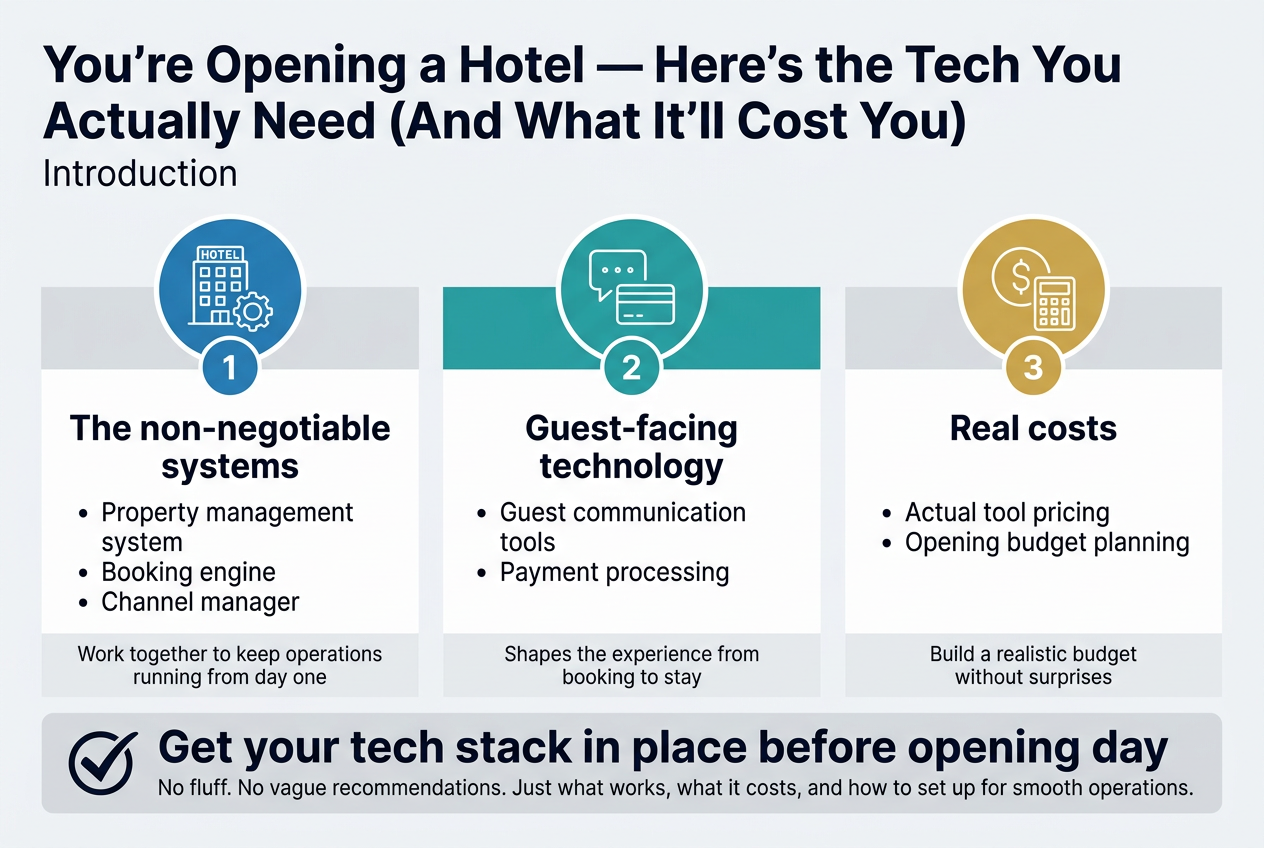
Here’s what we’ll walk through:
- The non-negotiable systems — from your property management system to your booking engine and channel manager — and how they work together
- Guest-facing technology — communication tools and payment processing that shape the experience from the moment someone books
- Real costs — a breakdown of what these tools actually run so you can build a realistic opening budget without surprises
No fluff, no vague recommendations. Just a straightforward look at what works, what it costs, and how to set your property up to run smoothly from day one.
Understanding the Core Hotel Tech Stack Before Opening Day
Why Technology Infrastructure Determines Guest Experience from Day One
A hotel’s technology infrastructure is not a background operational detail — it is the architecture that shapes every guest interaction from the moment a reservation is made. When your hotel tech stack is poorly chosen or hastily assembled, guests feel it immediately through slow check-ins, billing errors, and disconnected communication. Getting hospitality technology right before opening day sets the standard your property will be measured against from its very first review.
The Difference Between Essential and Nice-to-Have Systems
Not every hotel technology solution available on the market deserves a place in your pre-opening budget. Essential systems — those that directly support reservations, payments, room management, and guest communication — must be operational on day one without exception. Nice-to-have hotel automation tools, such as AI concierge platforms or advanced loyalty integrations, can be phased in once core hotel operations technology is stable and performing reliably across all departments.
How Early Tech Decisions Impact Long-Term Operational Costs
Hotel technology planning decisions made during the pre-opening phase have compounding financial consequences that extend years into operations. Choosing incompatible hotel software systems forces costly integrations later, while selecting scalable cloud hotel software from the start reduces long-term IT infrastructure expenses significantly. A well-defined hotel technology strategy and roadmap developed before opening day prevents expensive re-platforming, staff retraining cycles, and revenue loss caused by system downtime during peak occupancy periods.
Property Management System — The Foundation of Hotel Operations
Key Features to Look for in a PMS for New Properties
When building your hotel tech stack before opening day, the Property Management System (PMS) serves as the operational backbone of your entire hotel software ecosystem, connecting reservations, housekeeping, front desk, billing, and guest profiles into one centralized platform.
Cloud-Based vs On-Premise PMS — Which Makes Financial Sense
For new properties evaluating hotel technology infrastructure, cloud-based PMS solutions typically require lower upfront capital investment, faster deployment timelines, and reduced IT maintenance burden compared to on-premise systems, making them the more financially practical choice for hotels launching with lean operational budgets.
Typical PMS Pricing Ranges and Licensing Models
Hotel management software pricing generally follows subscription-based or per-room licensing models, with costs varying significantly based on property size, feature set, and vendor. New properties should evaluate total cost of ownership carefully, factoring in setup fees, training costs, integration expenses, and ongoing monthly licensing when budgeting for hotel technology procurement before opening day.
Booking Engine and Channel Manager — Maximizing Revenue From the Start
How a Direct Booking Engine Reduces Commission Dependency
A direct booking engine embedded on your hotel’s website allows guests to reserve rooms without routing through third-party platforms, eliminating the 15–25% OTA commission fees that erode revenue from the very first reservation your new property receives.
Connecting to OTAs Without Losing Control of Your Rates
A channel manager synchronizes your room inventory and pricing across all distribution platforms simultaneously, ensuring rate parity and preventing double bookings while keeping your revenue management strategy firmly under your control as part of a modern hotel tech stack.
Cost Breakdown for Booking Engine and Channel Manager Solutions
Solution Type | Estimated Monthly Cost |
Direct Booking Engine | INR 1000 – 2500/month |
Channel Manager | INR 1000 – 15000/month |
Combined Platform | INR 1500 – 15000/month |
- Setup and onboarding fees typically range from INR 5000 to 15000
- Commission-free direct bookings quickly offset initial hotel technology investment
- Cloud-based hotel software options reduce upfront infrastructure costs significantly
Point of Sale and Payment Processing Systems
Integrating F&B and Ancillary Revenue Into One System
For new properties, unifying food and beverage outlets, spa services, and other ancillary revenue streams into a single point of sale platform is essential for clean financial reporting and a seamless guest experience within your broader hotel tech stack.
Choosing Secure and Compliant Payment Processing Tools
Selecting hotel technology solutions that maintain PCI DSS compliance protects both guest payment data and your property’s reputation from day one, making security a non-negotiable pillar of your hotel technology infrastructure.
What New Properties Should Budget for POS Setup and Fees
Cost Component | Estimated Range |
POS Hardware (terminals, printers) | INR 25,000 – 55,000 per outlet |
Software Licensing with Installation (One Time) | INR 25,000 – 10,00,000 |
Software Licensing (monthly) | INR 2,000 – 20,000 |
Payment Processing Fees | 1.5% – 3.5% per transaction |
Training & Related Expenses | INR 10,000 – 40,000 |
With this in mind, hotel technology budgeting for POS should account for both upfront hardware investment and ongoing per-transaction fees, ensuring your hotel pre-opening technology plan reflects true operational costs without surprises after launch.
Guest Communication and Experience Technology
Pre-Arrival Messaging, Upselling and Digital Concierge Tools
Now that we have covered payment and point of sale systems, guest communication technology represents the next critical layer of your hotel tech stack. Pre-arrival messaging platforms allow properties to automate personalized emails and SMS touchpoints that confirm reservations, highlight amenities, and present upsell opportunities — such as room upgrades, spa packages, or early check-in — before the guest ever walks through the door. A digital concierge tool extends this capability further by enabling guests to submit special requests, ask questions, and receive curated local recommendations through a branded portal or mobile interface. For new hotels, these tools serve a dual purpose: they reduce front desk workload while simultaneously generating ancillary revenue from day one. Hotel automation features within these platforms can trigger communications based on booking window, guest segment, or stay type, making every interaction feel intentional rather than generic. Hospitality technology vendors in this space typically offer tiered plans that scale with property size, making them accessible even for boutique hotels and independent resorts entering the market.
In-Room Technology That Guests Actually Value
With this in mind, next we’ll examine which in-room hotel technology solutions genuinely influence guest satisfaction scores versus those that add cost without meaningful return. Guests consistently value high-speed, reliable Wi-Fi above nearly every other in-room technology investment — it remains non-negotiable across all segments, from budget to luxury. Smart TVs with casting capabilities, mobile-enabled room controls for lighting and temperature, and digital room service ordering through in-room tablets or personal devices rank closely behind. Smart hotel technology such as keyless entry via mobile app has also crossed from novelty into expectation at mid-scale and above properties. Conversely, in-room landline phones, printed compendiums, and standalone alarm clocks are increasingly seen as low-value items that consume budget without elevating the guest experience. For new hotel properties building their hotel technology infrastructure from scratch, prioritizing connectivity, casting-enabled entertainment, and mobile-first interaction points delivers the strongest return on technology investment.
Realistic Costs for Guest-Facing Communication Platforms
Previously, I’ve outlined the foundational systems that drive operations; guest-facing communication platforms carry their own distinct cost structure that new properties must factor into their hotel technology budgeting process. Below is a general cost overview for common guest communication and experience tools:
Technology | Typical Cost Range | Billing Model |
Pre-arrival messaging & upsell platform (Per Room) | INR 350/month | SaaS subscription |
Digital concierge / guest app | INR 5000/month | Per-property |
In-room tablet solution per room | INR 2000/month | Lease or SaaS |
Mobile check-in / keyless entry | INR 25000/month | Subscription |
Guest messaging (SMS/chat) | INR 2500/month | Usage-based or flat fee |
- Integration costs with your property management system can add one-time setup fees ranging from INR 5000 to 20,000 depending on the vendor.
- Hardware costs for in-room tablets or smart room controllers are separate from software licensing and should be budgeted independently.
- Boutique and independent hotels should prioritize platforms that offer PMS-native integrations to reduce friction during hotel software implementation.
When evaluating hotel technology investment in this category, total cost of ownership — including onboarding, training, and ongoing support — matters as much as the monthly subscription rate.
Revenue Management and Reporting Tools
Why Automated Pricing Tools Pay for Themselves Quickly
Automated pricing tools are among the most valuable components of any hotel tech stack, dynamically adjusting room rates based on demand signals, competitor pricing, and occupancy trends in real time — eliminating the revenue lost when rates are set manually and infrequently.
Essential Analytics Every New Property Needs From Day One
From the moment your property goes live, tracking key performance indicators such as RevPAR, ADR, and occupancy rate is non-negotiable. Without these foundational metrics embedded into your hotel management software from day one, operational blind spots accumulate quickly, making it nearly impossible to course-correct pricing or distribution strategies during those critical early weeks.
Affordable Revenue Management Options for Smaller Properties
Smaller and boutique properties don’t need enterprise-grade revenue management systems to compete effectively. Many cloud hotel software platforms now bundle lightweight revenue management and reporting dashboards directly into their core offering, giving independent operators access to automated pricing recommendations, channel performance reporting, and demand forecasting at a fraction of the cost of standalone solutions — making smart hotel technology genuinely accessible at every budget level.
Cybersecurity, Data Privacy and Compliance Requirements
Protecting Guest Data and Meeting PCI Compliance Standards
Every new hotel handling credit card transactions must meet PCI DSS (Payment Card Industry Data Security Standard) compliance before processing a single payment — non-compliance can result in heavy fines and reputational damage that no new property can afford.
Common Security Vulnerabilities New Hotels Overlook
New properties frequently underestimate risks like unsecured Wi-Fi networks, unpatched PMS software, weak staff password policies, and third-party vendor access points — each representing a potential breach vector within your hotel technology infrastructure.
Budgeting for Security Infrastructure Without Overspending
Security Layer | Estimated Annual Cost |
SSL Certificates & Firewall | INR 1,75,000 – 3,00,000 |
PCI Compliance Tools | INR 50,000 – 1,25,000 |
Staff Security Training | INR 50,000 |
Data Backup & Recovery | INR 1,25,000 |
With this in mind, prioritizing layered security within your hotel tech stack — rather than treating it as an afterthought — protects guests, preserves brand trust, and keeps your hotel digital operations legally sound from opening day forward.
Total Cost Summary and Smart Budgeting for Opening Day
A. Realistic All-In Tech Stack Budget Ranges by Property Size
Now that we have covered the individual components of a hotel tech stack, understanding how these costs accumulate across your entire operation is essential for sound hotel technology budgeting before opening day.
Property Size | Estimated Annual Tech Stack Cost |
Boutique (under 30 rooms) | INR 30,000 – 1,00,000 |
Mid-Size (30–100 rooms) | INR 75,000 – 3,00,000 |
Full-Service (100–300 rooms) | INR 2,50,000 – 10,00,000 |
Resort / Luxury Property | INR 5,00,000 – 14,00,000+ |
These ranges account for hotel management software licensing, hardware, integrations, onboarding fees, and ongoing support contracts across core systems.
B. Hidden Costs New Owners Often Miss During Pre-Opening
Hotel technology planning before opening frequently overlooks several budget-breaking line items:
- Staff training time and productivity loss during system onboarding
- Data migration fees when moving from legacy or trial systems
- Third-party integration costs between PMS, POS, and channel manager platforms
- Hardware procurement including terminals, tablets, routers, and servers
- Compliance and cybersecurity audits required before launch
- Vendor travel fees for on-site hotel software implementation and configuration
These hidden costs can add 20–35% on top of quoted software pricing.
C. Strategies to Phase Technology Investments Over Time
With this in mind, not every hospitality technology solution must be deployed simultaneously on day one. A phased hotel technology roadmap helps manage cash flow without compromising operations:
- Phase 1 (Pre-Opening): PMS, booking engine, channel manager, payment processing — non-negotiables for revenue capture
- Phase 2 (Months 1–3): Guest communication tools, basic reporting dashboards
- Phase 3 (Months 6–12): Revenue management systems, advanced automation platforms, loyalty integrations
This approach makes hotel technology investment sustainable while keeping your hotel digital operations fully functional from the moment doors open.
Conclusion
Opening a hotel is one of the most complex operational undertakings in hospitality, and building the right tech stack before day one is just as critical as designing the lobby or hiring the right staff. From your Property Management System serving as the operational backbone, to your booking engine, channel manager, POS, payment processing, guest communication tools, and revenue management systems — each layer plays a distinct role in keeping your property running smoothly and profitably from the very first check-in.
Cybersecurity and compliance cannot be an afterthought either, and understanding the true total cost of these systems helps you budget with confidence rather than scrambling for solutions under pressure. The smartest investment any new property owner can make is in thorough planning before opening day. Take the time to evaluate each component of your tech stack carefully, understand what you are paying for, and choose systems that can grow alongside your business. The right technology does not just support your operations — it defines the guest experience and sets the tone for your property’s long-term success.