
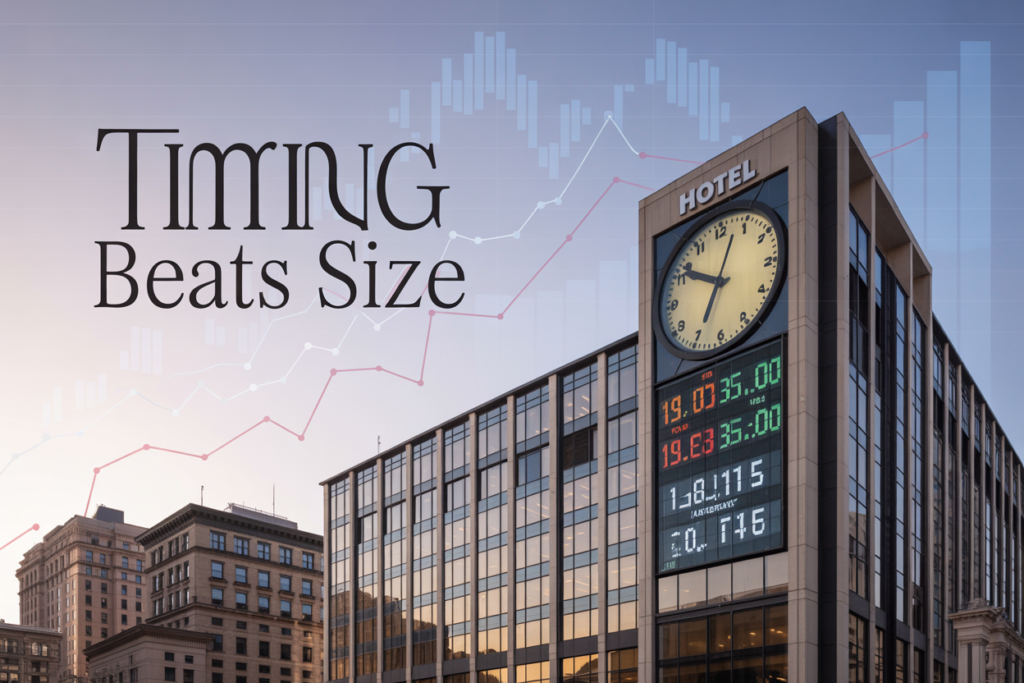
Hotel investors and developers usually chase the biggest budget they can get their hands on. But here’s the thing that’ll knock your socks off: the most successful hospitality projects share a totally different secret. Perfect timing beats deep pockets every single time.
Smart timing can turn a modest investment into exceptional returns. Poor timing? Well, it can sink even the most well-funded hotel project faster than you can say “vacancy rates.”
This guide is different for hotel developers, real estate investors, hospitality entrepreneurs, and private equity firms. You’re probably looking to maximize returns through strategic timing decisions instead of just throwing money at projects and hoping something sticks.
We’ll break down market timing fundamentals and show you how to read demand cycles like a seasoned pro. You’ll discover how launching at the right moment can slash your costs by 30-40% while boosting long-term profitability. Plus, we’ll explore operational readiness so you avoid that costly mistake of opening your doors when the market ain’t ready to fill your rooms.
The difference between a struggling hotel and a profitable one? It often comes down to when you decide to invest, not how much you spend.
Market Timing Fundamentals in Hotel Investment
Understanding Economic Cycles and Hotel Performance
Hotel investment success depends on understanding how economic cycles directly influence occupancy rates, average daily rates, and revenue per available room. It’s like reading the weather before you go sailing.
Economic downturns create acquisition opportunities at reduced valuations. Recovery phases generate optimal revenue growth periods for existing properties. Smart investors know this dance by heart.
Spotting Peak and Trough Investment Opportunities
Peak investment opportunities emerge during economic troughs when distressed assets become available below market value. This allows investors to capitalize on future recovery cycles – it’s basically buying low and selling high, but with better timing.
Trough opportunities occur during market peaks when exit strategies maximize returns through portfolio divestment. Or refinancing at favorable terms. The key is knowing which end is up.
Risk Assessment Based on Market Entry Points
Market entry timing significantly impacts risk exposure. Early-cycle investments offer lower acquisition costs but require longer hold periods. Late-cycle entries provide immediate cash flow benefits but face potential market correction risks.
Strategic timing analysis must evaluate demand cycles, supply pipeline, and macroeconomic indicators. This optimizes risk-adjusted returns and keeps you from stepping on financial landmines.
Capital Efficiency Through Strategic Timing
Maximizing Returns with Smaller Investments at Optimal Times
Strategic timing enables hotel investors to achieve superior returns even with limited capital. When market timing aligns with demand cycles, smaller investments can outperform larger investments made during unfavorable periods. It’s like David beating Goliath, but with spreadsheets.
Smart timing decisions focus on market entry points where supply-demand imbalances create opportunities. Enhanced profitability and accelerated ROI achievement follow naturally.
Avoiding Capital Traps During Market Peaks
Market peaks present significant capital traps where high investment costs coincide with saturated demand and inflated asset prices. During these periods, even substantial investments struggle to generate adequate returns due to compressed margins and increased competition.
Recognizing peak market indicators helps investors avoid committing large capital amounts. Timing conditions often favor delayed entry strategies for better long-term performance outcomes. Sometimes the best move is not making a move.
Leveraging Market Downturns for Higher Value Acquisitions
Market downturns create exceptional opportunities for value-driven hotel acquisitions at significantly reduced costs. During economic contractions, distressed assets become available below replacement cost. This enables investors to secure premium properties with smaller capital outlays.
This strategic timing approach allows acquisition of higher-quality assets. These would typically require substantially larger investments during normal market conditions. It’s like shopping during a clearance sale, but for hotels.
Operational Readiness and Market Conditions
Aligning Hotel Opening with Demand Recovery
Hotel project timing must synchronize with demand recovery cycles to maximize occupancy and revenue potential. Strategic developers analyze market indicators and economic forecasts before committing to opening dates.
This alignment prevents launching during market downturns, protecting initial investment returns. Nobody wants to throw a party when everyone’s broke.
Avoiding Oversupply Markets Despite Available Capital
Even with sufficient capital, investing in oversaturated markets creates unnecessary competition and reduced profitability. Smart hotel investment timing strategy prioritizes market analysis over funding availability.
This approach identifies underserved destinations where demand exceeds supply. It creates sustainable revenue streams regardless of investment size, demonstrating why timing affects hotel project profitability more than budget allocation.
Timing Renovations and Upgrades for Maximum Impact
Renovation timing directly influences guest satisfaction and operational efficiency. Properties scheduling upgrades during low-occupancy periods minimize revenue disruption while preparing for peak seasons.
Additionally, aligning renovations with market upswings guarantees improved facilities meet rising demand expectations. This creates competitive advantages that justify investment costs through enhanced pricing power and occupancy rates.
Financial Performance Metrics Driven by Timing
Revenue Per Available Room Optimization Through Market Entry
Strategic timing fundamentally drives RevPAR performance by aligning hotel openings with peak demand cycles. Hotels entering markets during economic upswings typically achieve 20-30% higher initial occupancy rates compared to those launching during downturns.
Market timing directly influences pricing power. Well-timed properties command premium rates while poorly timed entries face immediate revenue pressure from oversupplied markets. It’s the difference between being the only game in town versus fighting for scraps.
Break-Even Timeline Reduction with Strategic Timing
Market fundamentals demonstrate how timing reduces break-even periods significantly. Hotels launched during optimal market windows typically reach profitability 18-24 months earlier than those entering saturated markets.
This acceleration occurs because strategic timing eliminates the extended ramp-up phase required when competing against excessive supply. Properties achieve target occupancy levels faster when they’re not swimming upstream.
Exit Strategy Value Creation Through Cycle Management
Cycle management becomes crucial for maximizing exit valuations. Hotel investments timed to capitalize on market peaks during disposal can generate 40-60% higher returns than randomly timed exits.
Smart investors align their investment horizons with predictable market cycles. They position assets for sale during peak demand periods when buyer competition drives premium valuations and cap rate compression.
Risk Mitigation Through Timing Strategy
Reducing Construction Cost Volatility with Proper Scheduling
Strategic timing significantly reduces exposure to construction cost fluctuations. Launching hotel projects during stable material pricing periods and avoiding peak construction seasons minimizes budget overruns that can devastate project returns.
Managing Interest Rate Exposure Through Market Timing
Interest rate cycles present critical windows for hotel investment timing strategy for higher ROI. Securing financing during low-rate environments reduces carrying costs substantially.
Poor timing can increase debt service by 20-30% over project lifecycles. That’s a lot of money left on the table.
Minimizing Competition Impact with First-Mover Advantages
Market positioning becomes crucial once you’ve covered cost considerations. Early entry into emerging markets provides sustainable competitive advantages.
Hotels entering markets before saturation benefit from higher occupancy rates and premium pricing power. This demonstrates how timing influences hotel occupancy and revenue more than initial investment size alone.
The Bottom Line
The hotel investment landscape demands a fundamental shift in perspective. Stop focusing solely on capital size and start mastering the art of strategic timing.
Market timing fundamentals, capital efficiency, operational readiness alignment, and risk mitigation all converge to demonstrate one thing: when you enter the market matters more than how much you invest. Hotels that launch during optimal market conditions with proper operational preparation consistently outperform larger investments made during unfavorable periods.
Smart hotel investors recognize that timing creates multiplier effects that amplify returns regardless of initial capital constraints. By prioritizing market analysis, operational readiness, and strategic entry points, investors can maximize financial performance while minimizing risk exposure.
The most successful hotel projects aren’t necessarily those with the deepest pockets. They’re the ones that understand and leverage the power of perfect timing to transform modest investments into exceptional returns
.